LaVie Pure review — testing the UV water purifier and its scientific studies
With no filter and no cartridge, the LaVie Pure purifies tap water in 15 minutes using UV-A light. A French-made, low-running-cost solution whose every scientific report we have taken apart.
- ✓ Chlorine taste removed: more than 90% in 15 min (Aix-Marseille University assessment)
- ✓ E. coli reduced by 8.5 log in the lab, with no chemicals
- ✓ Zero cartridges: about €1.50 of electricity per 1,000 litres
- ✓ Point to watch: does not remove PFAS, heavy metals or microplastics
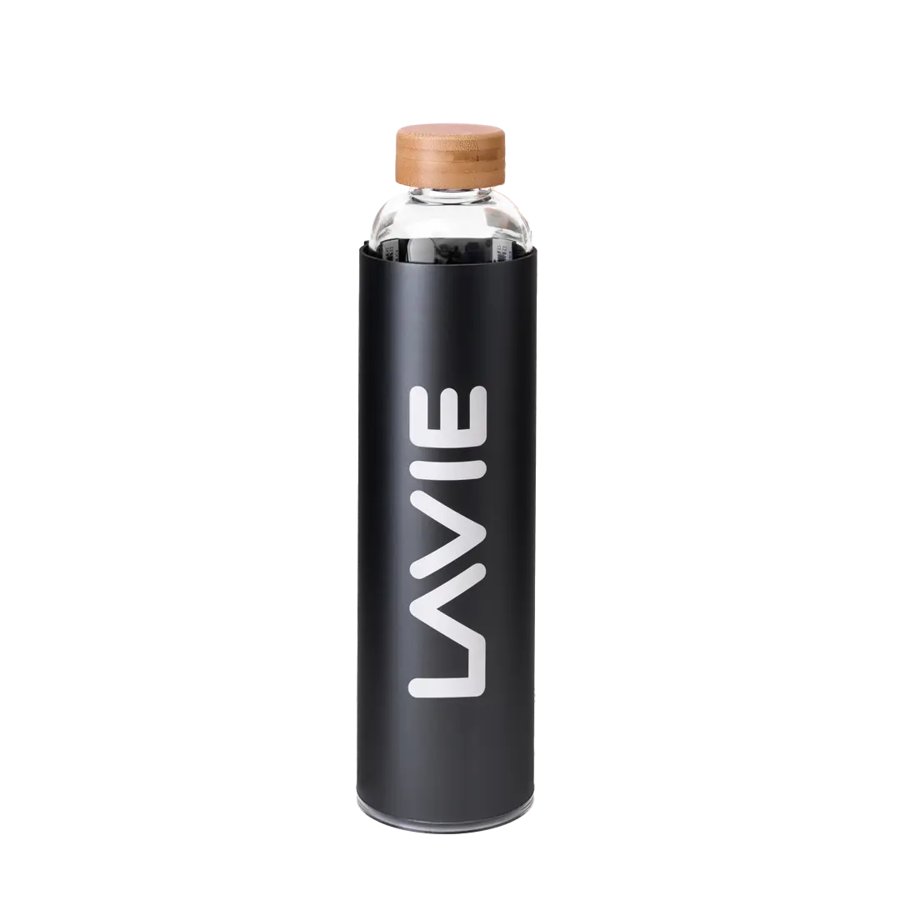
Image © LaVie
📋 Contents
Transparency: this article contains affiliate links. They do not change the price you pay and help us fund our tests and comparisons. Prices taken from the official LaVie website in September 2026 and subject to change.
Summary of our LaVie Pure review ⭐4/5
If you are searching for a LaVie Pure review, you are probably wondering whether a simple lamp can really “purify” tap water, with no filter and no cartridge. The answer is yes, but not for every pollutant. The principle is clever: instead of trapping contaminants in a filter that has to be replaced, LaVie uses the chlorine already present in the water as the fuel for an oxidation reaction triggered by UV-A light.
What we like: the water genuinely loses its chlorine taste, the device uses almost no power, there are no consumables to buy and the glass bottle is a great replacement for plastic multipacks of bottled water. Minerals (calcium, magnesium) stay in the water, unlike with a reverse osmosis system.
What stops us from rating it higher: the “up to 99.99% of pollutants” marketing claim goes further than what the studies show, and the LaVie Pure does not treat PFAS or heavy metals. For those pollutants, you need to pair it with a carbon filter, such as the LaVie OPROPRE we tested.
| Key data | LaVie Pure | What it means for you |
|---|---|---|
| Technology | UV-A LED photolysis (365 nm) | No filter, no cartridge, nothing added. |
| Cycle time | 15 min (22 or 30 min optional) | The time it takes to drink a coffee for 1 L of purified water. |
| Price | From €152.15 | Depending on the number of bottles (1, 4 or 6). |
| Running cost | ≈ €1.50 / 1,000 L | Electricity only, according to the brand. |
| LED lifespan | ≈ 50,000 hours | Around 10 years of stated average lifespan. |
| Materials | Aluminium, borosilicate glass, bamboo | Zero plastic in contact with the water. |
| Guarantees | 2 years + 30-day money-back guarantee | Free delivery in mainland France. |
How does the LaVie Pure purifier work?
The LaVie Pure consists of an anodised aluminium cylinder (31 × 9 cm, 1.5 kg) lined with UV-A LEDs and a borosilicate glass bottle closed with a bamboo stopper. You fill the bottle at the tap, leaving 1 to 2 cm of air, slide it into the base, and the cycle starts.
Photolysis: when chlorine becomes an ally
Mains water contains chlorine, added to disinfect it as it travels through the pipes. That is what gives it the swimming-pool taste. Under UV-A light, the chlorine molecules break down: this is photolysis. The reaction releases highly reactive radicals (notably hydroxyl radicals), which in turn oxidise bacteria and certain organic molecules such as pesticides or pharmaceutical residues.
🏆 Best filter jug: our comparison
All options compared to help you choose.
An important consequence: the effectiveness on pollutants depends on the amount of chlorine present in the water. The more chlorinated the water, the stronger the reaction. To learn more about the difference between filtering and purifying, read our guide to filtered vs purified water.
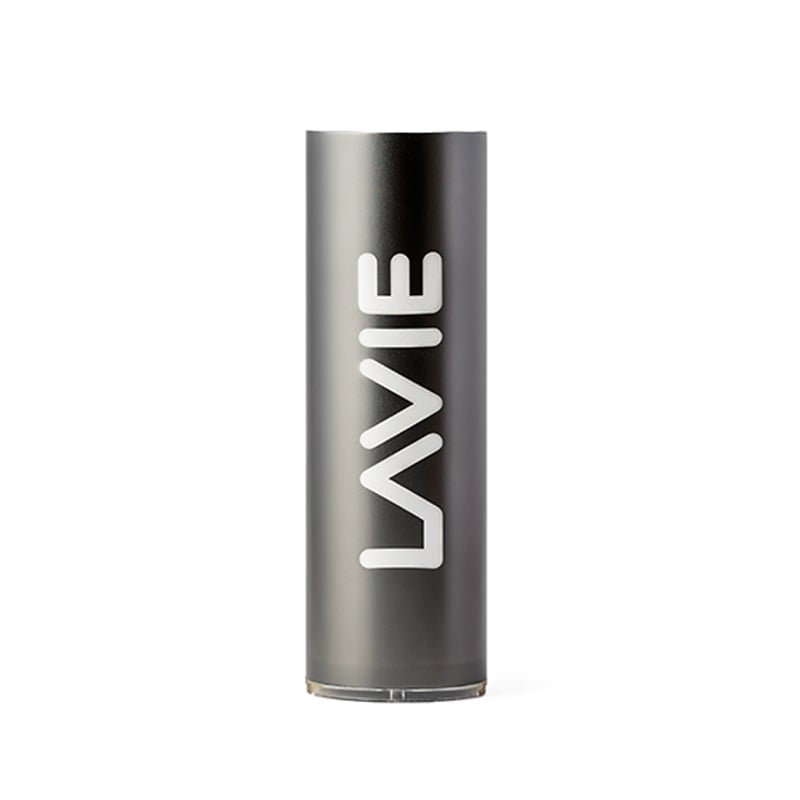
The aluminium base houses the UV-A LEDs: the bottle slides in for the 15-minute cycle · Image © LaVie
Three treatment modes
- Standard (green light): 15 minutes, the default mode.
- Intermediate (blue light): 22 minutes.
- Intense (red light): 30 minutes, useful if the chlorine taste persists or if the water is heavily chlorinated.
You switch modes with a small button under the base. During the cycle, the water warms up slightly (1 to 2 °C), which is why you need to leave a little air in the bottle.
LaVie Pure scientific reviews: what the studies really say
🏆 Best filter jug: our comparison
All options compared to help you choose.
LaVie highlights several scientific reports on its website. We read them all, not just their summaries. Here is what they demonstrate, under what conditions, and what they do not demonstrate.
Good to know before reading the figures: all these studies were carried out at the request of Solable, the company that makes LaVie, by university laboratories in Aix-Marseille. They are methodologically sound but have not been published in a peer-reviewed journal, and several were conducted on prototypes that predate the current model.
Chlorine: the best-demonstrated effect
In 2017, Prof. Nicolas Roche (Aix-Marseille University, M2P2 laboratory) measured more than 90% dechlorination within 15 minutes on tap water enriched with chlorine, with residual chlorine at the detection threshold, confirmed by an external laboratory. Work by the Laboratoire Chimie Environnement (LCE, Aix-Marseille University/CNRS) in 2020 also shows a drop of more than 80% in chlorine after irradiation. This explains why the swimming-pool taste disappears, and it is the most robust result of all the reports.
Bacteria: very effective on E. coli
The LCE report of December 2022 (revised in April 2023) exposed two strains of E. coli to a 15-minute cycle: no colonies were found afterwards, i.e. a reduction of about 8.5 log (well beyond 99.99%), with no regrowth after 24 hours. The authors nevertheless point out that the test was done in distilled water and that the effect on non-motile or more UV-resistant germs would need to be checked. A complementary study by the A5 Science laboratory (2023) observed the destruction of the bacterial wall under the microscope, without quantifying the removal rate. No test covers viruses.
Pesticides: a real but partial effect
On glyphosate, at a concentration close to what can be found in water (about 1 µg/L), the LCE measured removal of 42 to 95% depending on the trial, the variation depending on the chlorine level. On chlordecone, a very persistent pesticide, the summary published by the brand reports a reduction of 15 to 49% depending on the concentration and on added chlorine. Bisphenol A, also tested, had already disappeared before irradiation due to the chlorine alone.
Pharmaceutical residues: chlorine-dependent
This is the most revealing study. In 2019, the LCE tested diclofenac (an anti-inflammatory) and carbamazepine (an anti-epileptic). In lightly chlorinated tap water, the effect is weak: 0% on diclofenac and about 9% on carbamazepine. With more chlorinated water (about 0.56 mg/L), diclofenac is 100% removed and carbamazepine about 65%. The 2020 report confirms it: degradation increases almost linearly with the available chlorine. An important caveat: these trials were carried out with doses of pharmaceuticals far higher than those present in tap water, so that they could be measured.
| Pollutant tested | Measured result | Study |
|---|---|---|
| Chlorine | > 90% in 15 min | Prof. N. Roche, AMU (2017) |
| E. coli | ≈ 8.5 log (> 99.99%) | LCE AMU (2022-2023), distilled water |
| Diclofenac | 100% (chlorinated water) · 0% (lightly chlorinated) | LCE AMU/CNRS (2019-2020) |
| Carbamazepine | ≈ 65% (chlorinated water) · ≈ 9% (lightly chlorinated) | LCE AMU/CNRS (2019) |
| Glyphosate | 42 to 95% | LCE AMU (2022-2023) |
| Chlordecone | 15 to 49% | LCE AMU (brand summary) |
| PFAS, heavy metals, microplastics, nitrates | Not tested | Not affected by UV-A |
Our reading of the studies: the scientific basis of the LaVie Pure is real and more substantial than that of most consumer purifiers. The process works very well on chlorine and bacteria. On pesticides and pharmaceuticals, it reduces some of the molecules, especially if the water is well chlorinated, but the “99.99%” displayed by the brand does not apply to all pollutants. All sources can be consulted on LaVie’s scientific tests page.
UV-A light breaks down molecules; it does not trap anything. PFAS, heavy metals (lead in particular), microplastics and nitrates are not treated. Nor does it soften hard water. It is designed for mains water: with unchlorinated well water, the mechanism loses most of its benefit.
🛒 Want water with no chlorine taste?
Ships from France · 30-day money-back guarantee
Everyday use and maintenance
- Plug in the base: it flashes three times to confirm the adapter is recognised.
- Fill the bottle at the tap, leaving 1 to 2 cm of air.
- Slide it into the purifier: the cycle starts.
- Wait 15 minutes, then serve or put the bottle in the fridge.
Maintenance is minimal: no cartridge to change, a wipe of the base about once a month (white vinegar or bicarbonate of soda), and the bottle is dishwasher-safe, except for the bamboo stopper. Once opened, the water is ideally drunk within 48 hours, like mineral water.
The real constraint is the pace: one cycle treats one bottle at a time. That is why most households choose a pack of 4 or 6 bottles, so there is always one ready in the fridge.
LaVie Pure price and real cost
| Size | Observed price | Who it suits |
|---|---|---|
| Purifier + 1 bottle (1 L) | €152.15 €179 | One person |
| Purifier + 4 bottles (4 L) | €193.80 €228 | Couple or small family — our pick |
| Purifier + 6 bottles (6 L) | €220.15 €259 | Households of 4 or more |
Two people who each drink 1.5 L a day consume about 1,100 L a year. With mineral water at €0.30 per litre, that comes to nearly €330 a year. With the LaVie Pure 4 L at €193.80 and about €1.65 of electricity, the device pays for itself within the first year, and after that costs next to nothing: no cartridges, and LEDs designed to last about 10 years. Not to mention the hundreds of plastic bottles avoided. This calculation is an estimate that depends on your consumption.
💧 Never buy a replacement cartridge again
≈ €1.50 of electricity per 1,000 litres · LEDs designed to last ≈ 10 years
Who is the LaVie Pure for? Pros and limits
| Profile | Our view |
|---|---|
| You don’t like the taste of tap water | Ideal: the chlorine taste disappears, the minerals stay. |
| You want to stop buying bottled water packs | Very relevant: pays for itself in a year, zero plastic waste. See also why you should stop drinking bottled water. |
| You rent or hate plumbing | Perfect: nothing to install, all you need is a socket. |
| Your area reports PFAS or lead | Not enough on its own: pair it with an activated carbon filter or choose a certified under-sink filter. |
| Well or borehole water | Not recommended: without chlorine, the mechanism loses most of its effectiveness. |
✅ What we like
- Chlorine taste removed, demonstrated in the lab
- No filters or cartridges to buy
- Near-zero running cost
- Minerals retained
- Glass, aluminium, bamboo: zero plastic
- University studies available online
- 30-day money-back guarantee
⚠️ Things to watch
- Does not treat PFAS, heavy metals or microplastics
- Effectiveness on pollutants tied to the chlorine level
- Studies commissioned by the brand, not published in a journal
- 15-minute wait per bottle
- Glass bottle to be handled with care
Customer reviews: what users say
LaVie claims more than 50,000 equipped households, and the brand states that 99% of its customers give it 4 or 5 stars. Feedback converges on four points: a much more neutral taste that makes you want to drink tap water, the simplicity of a cartridge-free device, the refined design in glass and bamboo, and no more carrying packs of bottles.
The most frequent complaint concerns the 15-minute wait. The workaround is simple: get several bottles and always keep one in the fridge.
Torn between this and a classic filter jug? Compare with our review of the LARQ PureVis UV-C carafe, which filters and purifies at the same time.
Our verdict: should you buy the LaVie Pure?
Yes, if your priority is to drink pleasant, sanitised tap water with no cartridges and no plastic. The LaVie Pure does what it does very well: removing chlorine, neutralising bacteria and reducing some of the organic pollutants, for a negligible running cost. Its scientific basis is more transparent than that of most competitors, even if the results are more nuanced than the sales pitch.
If you live in an area affected by PFAS or lead, don’t rely on it alone: combine it with an activated carbon pre-filter. And to compare all countertop solutions, see our comparison of the best filter jugs.
LaVie Pure: tap water with no chlorine taste and no cartridges
UV-A light purifies your water in 15 minutes, keeps its minerals and costs next to nothing to run. Designed in Provence, tested by Aix-Marseille University.