
📋 In this article
Tap water in France costs around €0.004 per litre, which is up to 300 times cheaper than plastic bottles.
However, between the unpleasant taste of chlorine and the threat of invisible pollutants, it’s becoming difficult to drink with peace of mind on a daily basis. We’re here to help you choose the best solution to improve the quality of your water at home and protect your health in the long term 💧.
Improving water quality: understanding today’s pollutants
In France, 30% of water catchments have closed since 1980 due to PFAS, nitrates and pharmaceutical residues. Filtering at home using osmosis or activated carbon makes drinking water safe whilst removing limescale and the taste of chlorine.
To protect your health, learn to spot the signs your senses send you every day.
Signs that your water at home is poor quality
Can you smell that swimming pool odour? It’s chlorine, a necessary but harsh disinfectant. Unfortunately, it alters the taste of your coffee and food.
Take a look at your taps: white limescale is unforgiving. It builds up on shower walls. Your laundry often feels stiff after washing.
Check the clarity of the water. Cloudy water often indicates suspended particles.
But beyond what you can see, far more insidious dangers are circulating in your pipes.
Invisible threats: from lead to PFAS ‘forever chemicals’
Medicines and microplastics sometimes find their way into our glasses. These substances breach conventional barriers. Europe is stepping up monitoring of new pollutants to protect us.
PFAS, or ‘forever chemicals’, affect our endocrine system. These chemical molecules accumulate in the human body over the long term.
Let’s not forget the lead in old pipes. This heavy metal poses a direct threat to the development of young children.
⚠️ Pollutant Alert
PFAS (forever chemicals), pharmaceutical residues, microplastics and lead from old pipes are invisible but very real dangers.
3 filtration solutions for healthy water every day
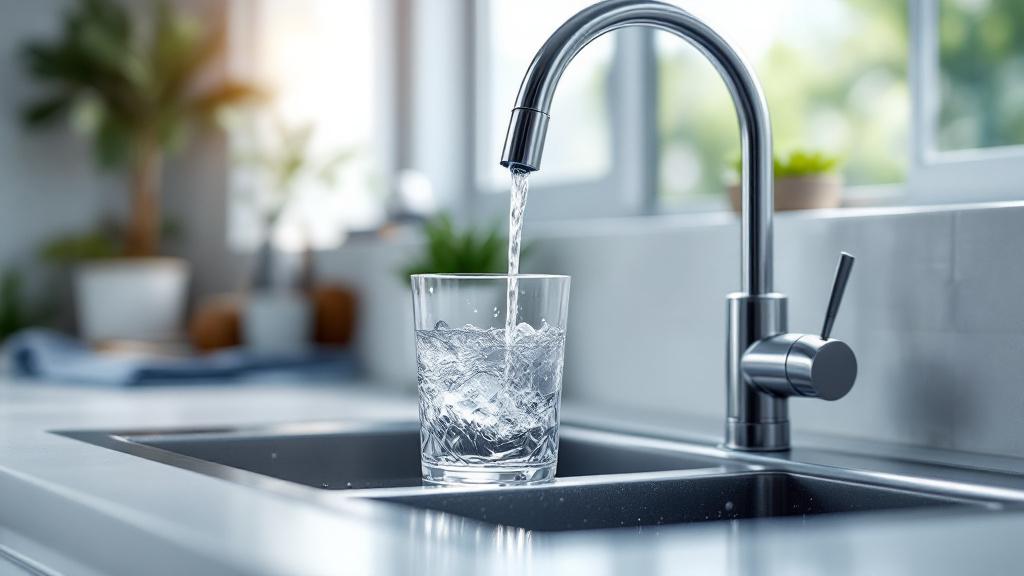
To counter these threats, several domestic technologies allow you to regain control over water purity.
The filter jug and activated carbon for taste
Activated carbon effectively adsorbs chlorine. It instantly improves the taste and texture of tap water. Check the effectiveness of the glass jug here.
Be aware, however, of the technical limitations. This system struggles to remove nitrates or heavy metals completely.
Maintenance is vital. A saturated filter can release bacteria.
The under-sink filter: performance and discretion
This device connects directly to the cold water supply. It offers a much higher flow rate than standard jugs. It’s ideal for improving water quality simply.
- Concealed installation under the worktop
- High-capacity cartridge
- Instant filtered water from the tap
The filtration is finer and more durable. It provides better protection against sediment and certain stubborn chemical residues.
Reverse osmosis for near-absolute purity
The semi-permeable membrane filters at a molecular level. It allows almost only pure water molecules to pass through.
This system removes 99% of viruses, bacteria and pollutants. Here is our selection of the best reverse osmosis system for your health.
Reverse osmosis is currently the most advanced technology for ensuring water free from chemical contaminants.
| Criteria | Jug | Reverse osmosis system |
|---|---|---|
| Efficiency | Chlorine | Absolute purity |
| Maintenance | Frequent | Annual |
Water softener: the defence against aggressive limescale
While filtration ensures purity, water softening tackles the mineral hardness that corrodes your plumbing.
How ion exchange works to protect your home
The ion exchange resin captures calcium and magnesium ions. It replaces them with sodium to remove limescale. This chemical process radically transforms the nature of your domestic water.
Your household appliances will therefore last much longer. The heating elements in your water heater remain clean and efficient. You avoid costly breakdowns and unnecessary energy wastage in your daily life.
| Equipment | Without a water softener | With water softener |
|---|---|---|
| Washing machine | Rapid limescale build-up | Full protection |
| Boiler | Reduced lifespan | Optimised longevity |
| Fittings | Limescale deposits | Preserved shine |
| Skin/Hair | Irritation and dryness | Restored softness |
Why a water softener is no substitute for a water purifier
Softening is not the same as purifying. The appliance removes limescale but allows pesticides and chlorine to pass through freely. For maximum safety, aim to remove metals and chemical pollutants with a complementary system.
Softened water is higher in sodium. It is therefore best to filter drinking water separately. It’s a matter of taste and health.
The ideal combination? A water softener for the mains supply and a reverse osmosis system for the kitchen.
Cost-effectiveness and environmental impact of ditching bottles
Beyond convenience and health, switching to filtered water radically transforms your budget and your carbon footprint.
Calculating the savings on your annual budget
Tap water costs around €0.004 per litre. By comparison, bottled water is up to 300 times more expensive. It’s a financial drain on households.
A four-person household saves hundreds of euros a year. The investment in a quality filter often pays for itself in less than twelve months. Here are the figures:
- Annual cost of bottled water: ~€500
- Annual cost of filters: ~€80
- Net saving: €420
★ Key figures
Tap water is 300 times cheaper than bottled water. The net saving is estimated at €420 per year for a four-person household.
No more lugging heavy packs around. You have an endless supply straight from your tap.
Massive reduction in plastic waste and carbon footprint
Getting rid of bottles prevents thousands of pieces of plastic waste. Only a small percentage of this plastic is actually recycled today. It is an avoidable ecological disaster.
Transporting bottled water generates massive pollution. Using local water drastically reduces CO2 emissions linked to road transport, in line with the national water protection strategy.
Switching to a reusable water bottle is a simple step. It is the most consistent solution for responsible hydration.
To protect your health, purify your water by removing chlorine, PFAS and heavy metals using a reverse osmosis system or an under-sink filter, whilst protecting your plumbing from limescale with a water softener. By adopting these solutions to improve water quality, you will make long-term savings and take concrete action for the planet. Finally, give your family absolute purity with every sip.